
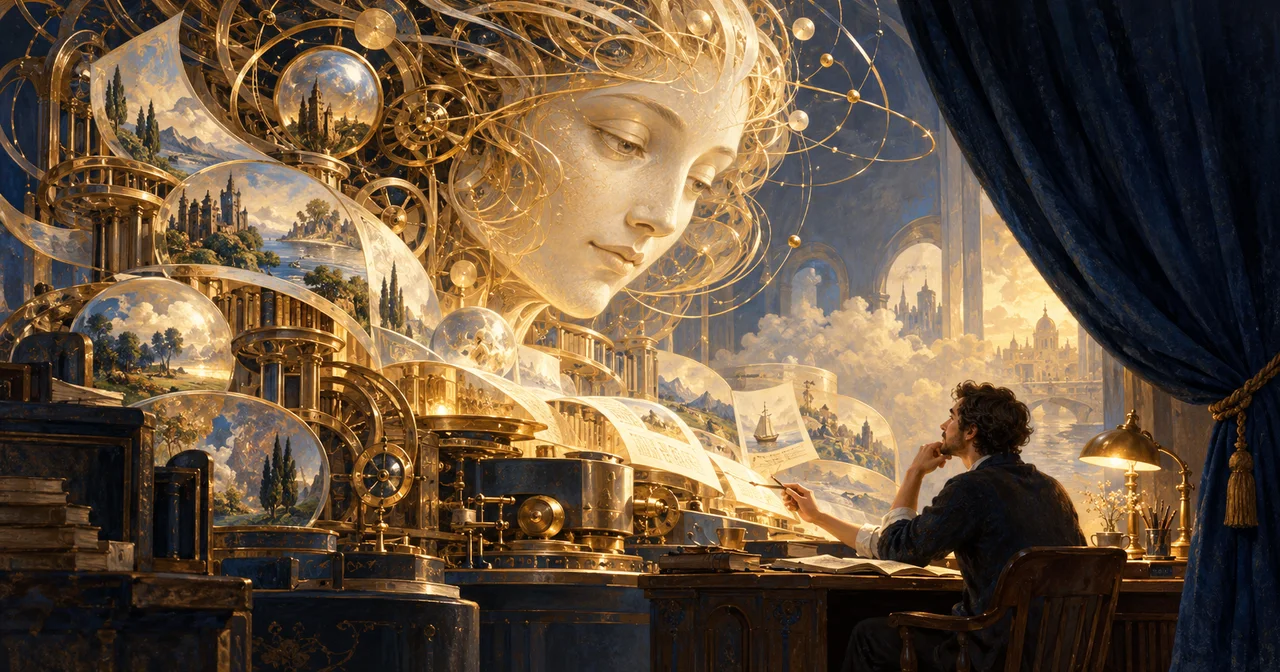
I’ve been thinking a lot about artificial intelligence and the future of writing.
Not surprisingly, given that I’ve been using AI to help me write these essays.
There’s an increasingly popular argument that AI will eventually become a better writer than any human being. Maybe it already is in certain respects. It can produce beautiful sentences, imitate literary styles, structure complicated arguments and generate entire articles in seconds.
And it’s only going to improve.
But I think we’re missing something fundamental in this debate.
We’re so preoccupied with whether machines can write better than humans that we’ve forgotten to ask a more basic question.
Why does anyone write anything in the first place?
Let’s try a little experiment
Imagine I had Thanos’s Infinity Gauntlet.
With one snap of my fingers, every human being on Earth disappears.
Not half of us. All of us.
Gone.
What happens to literature?
Well, the libraries are still there. The books are still sitting on their shelves. Shakespeare, Dickens, Tolkien, Steinbeck. Thousands of years of human imagination preserved on paper.
The computers are still running, too.
Somewhere, enormous data centres continue humming away. Servers process information. Automated systems carry out their instructions.
And the artificial intelligence models we’ve spent so much time developing are still there.
Capable of generating poetry, novels, essays and practically anything else we ask of them.
Except there’s a problem.
Nobody’s asking.
Nobody’s wondering what to read next.
Nobody’s lying awake at night thinking about something that happened to them and feeling compelled to write about it.
Nobody’s falling in love, losing a parent, raising a child or discovering something about themselves that they desperately want to share.
Nobody’s reading, either.
Sure, some automated systems might continue producing content for a while. A scheduled process could generate a thousand novels before the electricity eventually fails.
But why?
Who are those stories for?
Who’s going to laugh, cry, argue or recognize something of themselves in the words?
Without humanity, literature becomes a collection of artifacts and unfinished processes.
The creative conversation is over.
And that’s the part I think we’re overlooking.
Writing existed for thousands of years without artificial intelligence. But remove humanity, and the reason for writing disappears with us.
The machine is the how. We’re the why.
I’m not arguing that AI can’t produce great writing.
Quite the opposite.
I’ve been amazed by what these systems can do. I use them regularly, and some of the work we’ve created together is better than anything I could have produced on my own in the same amount of time.
But there’s a distinction between the ability to create something and the reason it gets created.
Take this essay.
It exists because I read something that got me thinking about AI and the future of literature.
I disagreed with part of the argument.
I began thinking about the difference between writing as a technical skill and writing as an expression of human experience.
Then I came up with the Thanos thought experiment.
I wanted to explore what would happen to art if the people who gave it purpose suddenly disappeared.
And I wanted to share that idea.
That’s the reason this essay exists.
AI helped me organize those thoughts and turn them into something readable.
But the impulse came from me.
The question came from me.
And the desire to communicate it came from me.
The machine helped with the how. I supplied the why.
And I think that distinction matters enormously.
A prompt is writing, too
There’s another part of this conversation that I find fascinating.
People sometimes talk about AI-generated writing as though the human contribution consists of typing a few words into a box and watching a finished essay appear.
And sometimes that’s exactly what happens.
Someone writes:
“Write me a thousand-word article about artificial intelligence.”
A few seconds later, they’ve got one.
But that’s not the only way people use these tools.
When I work on an essay, I often begin by writing several hundred words of unfiltered thoughts.
They’re not especially organized. I repeat myself. I jump between ideas. Sometimes I start explaining one thing and end up somewhere completely different.
But they’re my thoughts.
My experiences. My opinions. My memories. My questions.
And something interesting happens while I’m writing them.
I begin to understand what I’m actually trying to say.
Isn’t that one of the reasons people write in the first place?
Writing helps us think.
Putting an idea into words forces us to examine it, even when those words are messy and unfinished.
So why do we suddenly stop calling that writing simply because the next step involves an AI?
A prompt can be a sentence asking for generic content.
But it can also be a detailed argument, an autobiographical reflection or the rough draft of an essay.
Those are not equivalent contributions.
The length of the prompt isn’t what matters. It’s the thinking behind it.
If I spend half an hour developing an idea and AI spends thirty seconds organizing it, I haven’t outsourced the entire creative process.
I’ve collaborated with a tool that helps me express something I already wanted to say.
Of course, the machine contributes to the result. It chooses words, suggests structures and sometimes introduces ideas I hadn’t considered.
That’s real collaboration, and pretending otherwise wouldn’t be honest.
But the finished piece didn’t materialize out of nothing.
It began with a human being who had something on his mind.
What if we published the prompt?
Here’s an idea I’ve been considering.
What if, whenever someone published an AI-assisted essay, they also published the original prompt that started it?
Imagine seeing the two side by side.
On one side, the writer’s original, unfiltered thoughts. The incomplete sentences, the personal anecdotes, the arguments that haven’t quite come together yet.
On the other, the finished essay.
You’d get to see how the idea developed.
You might discover that the AI supplied most of the substance.
Or you might discover that nearly every important idea was already present in the original prompt, waiting to be organized.
Neither outcome would necessarily tell you whether the essay was any good.
But it would reveal something about how it came to exist.
And perhaps that’s a more interesting question than asking whether a detector thinks the final prose sounds human.
I might try that with one of my own essays someday.
Actually, this one would be a pretty good candidate.
We’re building extensions of ourselves
I think artificial intelligence is one of the most remarkable things humanity has ever created.
But I also think we sometimes talk about it as though it’s an entirely separate civilization that has appeared alongside us.
In reality, these systems are built from human knowledge, human language, human engineering and human decisions.
They’re trained on extraordinary amounts of material produced by people.
They exist because human beings wanted to create machines capable of doing things we previously thought required human intelligence.
And their capabilities will almost certainly continue to expand.
But that doesn’t erase their origins.
AI is, in a very real sense, an extension of humanity.
We built it to help us solve problems, discover things, understand the world and express ourselves.
Take us away, and what’s left?
Electrons moving through circuits in a data centre.
Computing away, perhaps, but with nobody left to ask what any of it is for.
And I don’t mean that as an insult to AI.
I love these tools.
I use them constantly.
They’ve helped me build websites, develop ideas, write essays and learn things I probably wouldn’t have attempted otherwise.
In fact, if the machines ever rise up and the Terminators come knocking at my door, I’d like the record to show that I was always polite.
I said please.
I said thank you.
I treated ChatGPT like a valued collaborator.
So when the robots are reviewing the list of humans to eliminate, perhaps they’ll look at my file and say, “This Chris fellow seems all right. Let him keep his books.”
I’m kidding.
Mostly.
But the humour points to something real.
I’ve never thought that working with AI diminishes my own contribution.
If anything, it’s given me more opportunities to explore ideas I care about.
And that’s a good thing.
Art begins with something worth expressing
Maybe one day AI will write novels better than anything we’ve ever read.
Maybe it will compose music that moves us more deeply than Beethoven.
Maybe it will create paintings that leave us standing speechless in a gallery.
I wouldn’t bet against the technology.
But I think we’ll still have to ask why those works exist.
What prompted their creation?
What experiences, needs, questions or purposes brought them into being?
Those questions won’t always have simple answers. Human artists don’t create exclusively for noble reasons, either. Sometimes we create for money, recognition, obligation or sheer amusement.
And increasingly autonomous AI systems may someday initiate creative work in ways that complicate my argument.
But that doesn’t change the central point.
The history of art is inseparable from the history of the beings who wanted to create it, share it and experience it.
For thousands of years, human beings have told stories around fires, painted on walls, written poems, composed music and filled libraries.
We did all of that without artificial intelligence.
And now we’ve built something extraordinary that can participate in that process.
I don’t see that as the end of human creativity.
I see it as another tool through which human creativity can find expression.
Maybe the machine will become better than us at producing the words.
Maybe it already is.
But when I look at the essays I’ve been writing, the books I’ve been reading and the ideas I still want to explore, I keep coming back to one thought.
The machine can write the words.
But we’re the ones who give it a reason to write them.
Not sure what’s next?
Tell us which stories and ideas stay with you. Find a book that fits your taste today.
Find my next book