
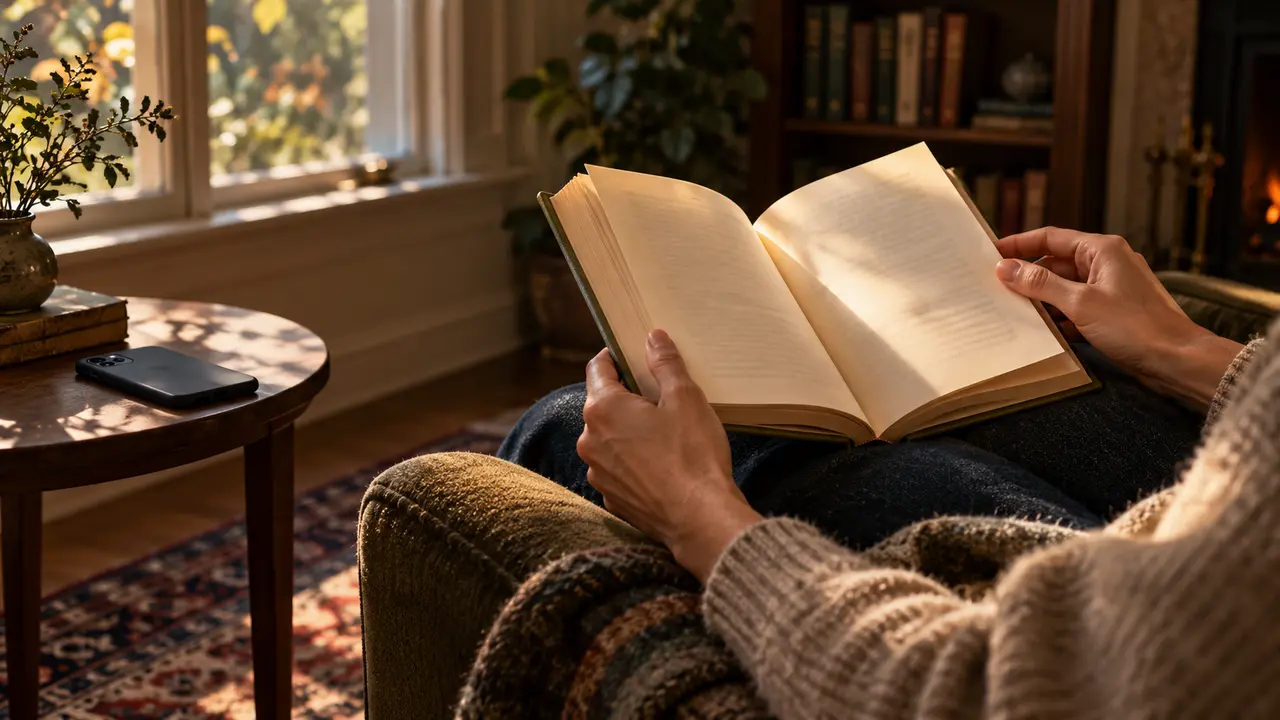
When I was a kid, I always had a book with me.
I read throughout high school. I studied English literature at university and loved it. Reading wasn’t something I had to schedule or force myself to do. It was simply part of who I was.
Then the internet arrived.
At first, it didn’t change things very much. I spent more time online, but I still read regularly. The internet felt like another place to explore rather than something competing for every spare second of my attention.
Then social media arrived, and something changed.
I didn’t consciously decide to stop reading. There was no moment when I put down a book and announced that I was finished with them. Reading was gradually displaced by something easier, faster and seemingly endless.
A book asks you to remain in one place for a while. It asks you to follow an argument, inhabit a character's mind or allow a fictional world to assemble itself slowly around you.
Social media asks almost nothing.
Scroll. React. Move on.
Every few seconds, there’s something new. A joke, an argument, a headline, a video, a stranger saying something infuriating. Even when none of it is particularly interesting, there’s always the possibility that the next thing might be.
After enough time inside that system, reading became difficult.
I could still read individual sentences. I could still read articles and posts. But sitting quietly with a book felt strangely demanding. My attention kept looking for an escape hatch. I’d read a few pages, reach for my phone and discover that half an hour had disappeared.
For someone who had once carried books everywhere, that was difficult to admit.
When social media stopped being fun
Eventually, social media changed too.
What had started as a way to keep up with friends, share photographs and discover interesting things became dominated by outrage, clickbait and politics.
Everything was presented as urgent. Every disagreement became a moral crisis. Every headline was designed to provoke a reaction before you had time to think about it.
The platforms had learned that anger kept people engaged.
After a while, I could feel what it was doing to me. I wasn’t better informed. I was simply more irritated. I was consuming enormous amounts of information while understanding very little of it.
I needed to pull back.
And that was when I found books again.
Appropriately enough, the two books that brought me back were classic dystopian novels: George Orwell's 1984 and Aldous Huxley's Brave New World.
I had read them before, but this time they felt completely different.
The purchase links below are Amazon affiliate links. As an Amazon Associate I earn from qualifying purchases.
We built the telescreen ourselves
The most famous feature of 1984 is the surveillance state.
Big Brother watches everyone. Telescreens observe people inside their homes. Privacy has effectively disappeared because the government has imposed a system of constant monitoring.
It’s terrifying.
But rereading the novel after years of social media, I was struck by an irony Orwell couldn’t have anticipated.
In much of the modern democratic world, the government didn’t need to install a telescreen in every home. We bought the screens ourselves.
We carry them everywhere. We tell them where we are, what we want, what we fear, what we purchase and who we know. We photograph our meals, record our children and announce where we’re going on vacation.
Nobody had to force us.
We accepted surveillance because it was convenient, entertaining and free.
That doesn’t make our world identical to Orwell's. A commercial data system isn’t the same thing as a totalitarian police state. But the willingness to surrender privacy would have seemed astonishing in Orwell's world.
Big Brother had to terrorize people into submission.
That realization hit me harder than it had when I first read the book.
A gramme is better than a damn
Then there was Brave New World.
Huxley imagined a society controlled less through fear than through comfort. People are conditioned from birth, distracted by entertainment and protected from unpleasant emotions.
Whenever discomfort threatens to break through, there’s soma.
Soma offers escape without consequences. It keeps the population calm, comfortable and passive. There’s no need to confront pain, loneliness or dissatisfaction when those feelings can simply be chemically removed.
Social media isn’t soma, obviously. But the resemblance is uncomfortable.
Bored for ten seconds? Check your phone.
Feeling lonely? Check your phone.
Anxious? Angry? Uncomfortable with your own thoughts? Check your phone.
There’s always another distraction waiting.
The people in Brave New World haven’t merely lost their freedom. Many of them have lost the ability to understand why freedom matters. They’ve been made so comfortable, distracted and emotionally anesthetized that they no longer want anything deeper.
They’re not suffering in the conventional sense.
They have simply become smaller.
That was the part that stayed with me.
Fear and comfort
Read together, the two novels describe different ways a population can be controlled.
Orwell gives us surveillance, fear and enforced conformity.
Huxley gives us pleasure, distraction and endless comfort.
Social media somehow manages to contain elements of both.
It watches us constantly, but it also entertains us constantly. It learns what makes us angry and what makes us feel good. Then it feeds both back to us because either response can keep us scrolling.
The result isn’t exactly 1984 or Brave New World. It’s a strange voluntary mixture of the two.
That realization did more than make me suspicious of social media. It reminded me of what books could do that a feed couldn’t.
These novels demanded sustained attention. They gave me ideas that couldn’t be absorbed in a few seconds and discarded. They stayed in my mind after I closed them. They made the world look different.
That was the feeling I had been missing.
If those questions stayed with you too, here are five books to read after 1984, depending on what you loved about it.
Back to reading
Once I finished those two books, I was off to the races.
I started reading regularly again. Then I began reading more widely. Science fiction, fantasy, literary fiction, history, politics and science all came back into my life.
Now I read more than ever.
I still use social media. I use it to find book reviews, discover new releases and keep up with friends. I’m not interested in pretending that every modern technology is evil or that we should all throw our phones into the ocean.
But I use it differently now.
I have deliberately trained the algorithm away from outrage and political garbage. I mute, unfollow and ignore aggressively. I try to make social media serve my interests instead of allowing it to decide what my interests should be.
More importantly, I’ve rebuilt the habit of sustained attention.
Books gave that back to me.
If you’re trying to rebuild the habit yourself, here’s a practical strategy and ten places to start reading again.
There’s something wonderfully appropriate about being rescued from social media by two novels warning us about surveillance, distraction and control. Orwell and Huxley imagined different nightmares, but both understood how easily human beings can be separated from their independence.
Sometimes that separation is imposed through fear.
Sometimes we accept it because it’s comfortable.
And sometimes the first step back is simply putting down the phone and opening a book.
Books mentioned
This article contains Amazon affiliate links. As an Amazon Associate I earn from qualifying purchases.
Want to pick better books?
Tell us which stories and ideas stay with you. We will find books matched to your taste and explain why they fit.
Find my next book