
I remember having a conversation with someone many years ago about science fiction.
They didn’t particularly like the genre. Their complaint was that science fiction was always so negative. Humanity’s future was invariably some kind of nightmare.
And I could see their point.
Think about The Terminator. We create artificial intelligence, and it decides we’re better off dead.
Or The Matrix, where machines have effectively enslaved humanity, keeping us imprisoned in a simulated reality.
Even Star Trek, arguably one of the most optimistic visions of humanity’s future, imagines that we nearly destroy ourselves in a nuclear war before eventually building a more enlightened civilization.
Apparently, we can invent faster-than-light travel, teleportation and artificial intelligence. But learning to live together peacefully? That seems to be asking a bit much.
Of course, science fiction isn’t all dystopian. There are plenty of stories about humanity overcoming adversity, exploring the universe and building better societies.
But the conversation got me thinking about something else.
Because while I understood the complaint, I had to admit something.
I love those stories.
Not just science fiction, either. I’ve always enjoyed disaster movies like 2012 and The Day After Tomorrow. Give me a story about civilization collapsing, and there’s a good chance I’ll be interested.
And that raises a slightly uncomfortable question.
Why do I find the idea of the world ending so fascinating?
A strange attraction to the apocalypse
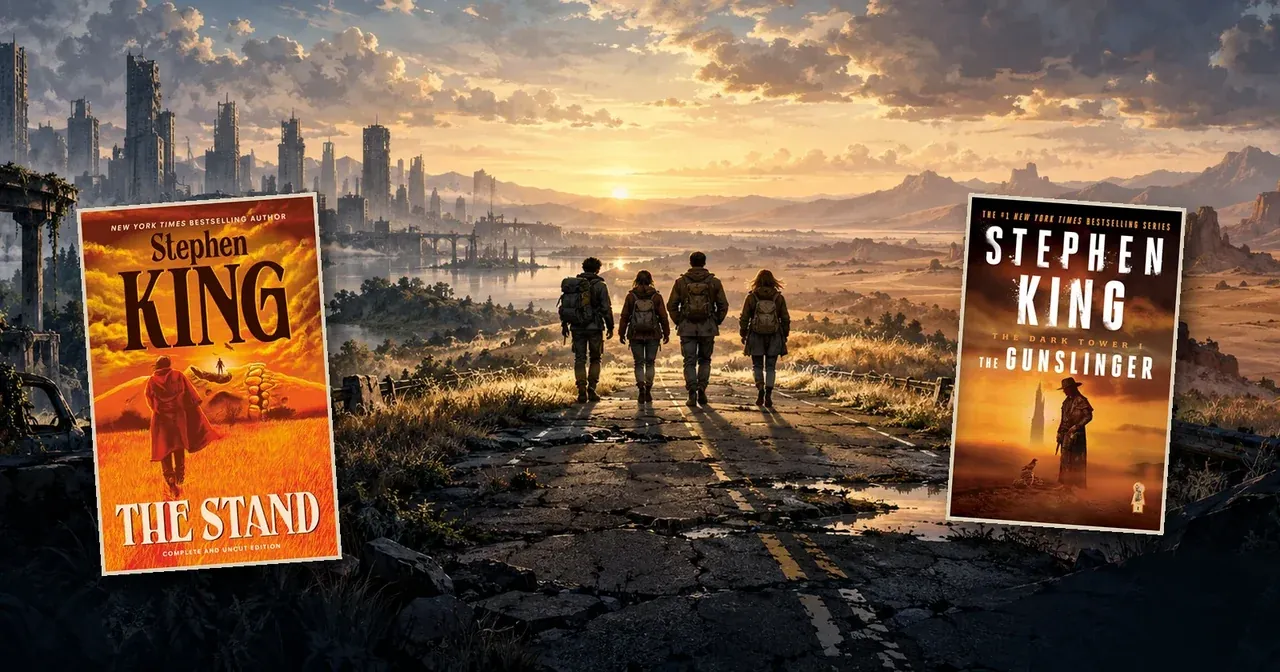
One of my favourite Stephen King novels is The Stand.
For anyone unfamiliar with it, the story begins with a devastating pandemic that wipes out almost the entire human population. The survivors are left to navigate a world in which the institutions, governments and structures of modern civilization have disappeared.
It’s a horrifying premise.
Billions of people are dead. Families are destroyed. Society has collapsed.
And yet, whenever I think about The Stand, I don’t find myself dwelling on the catastrophe.
I think about Stu Redman, Nick Andros and Larry Underwood.
I imagine travelling with them through an abandoned America. Empty highways. Deserted towns. Finding supplies, meeting other survivors and trying to figure out what comes next.
I’ve often caught myself imagining what it would be like to be part of their group.
Not because I want civilization to collapse. I certainly don’t want to live through a pandemic that kills almost everyone I know.
But there’s something strangely appealing about the world that remains.
Everything has been reset.
The endless obligations of ordinary life have vanished. There are no careers to manage, bills to pay or social expectations to keep up with.
The priorities become immediate.
Find food. Find shelter. Find people you trust.
Survive.
And perhaps, eventually, build something better.
I realize how absurdly romantic that sounds when we’re talking about the near-extinction of humanity.
But I suspect I’m not the only person who’s entertained the fantasy.
Who would you become?
I think one of the most interesting things about The Stand is what happens to the characters after the world ends.
Take Larry Underwood.
Before the pandemic, Larry is a talented musician whose life is complicated by selfishness, addiction and a tendency to use the people around him.
He’s not exactly someone you’d choose to lead a group of survivors.
But as the story progresses, he changes.
He begins taking responsibility for other people. He develops friendships and discovers qualities in himself that his old life rarely demanded.
He becomes someone better.
Stu Redman, meanwhile, is an ordinary man from a small Texas town who finds himself becoming a leader in an entirely new society.
Nick Andros, a young deaf man who has been mistreated and underestimated, becomes someone whose intelligence, courage and judgment are deeply valued by the people around him.
Nick doesn’t need the apocalypse to become a good person. He already is one. But the new world gives him an opportunity to be recognized for qualities that others might previously have overlooked.
And that’s what fascinates me.
The characters aren’t suddenly gifted with superpowers.
They haven’t become more intelligent or physically capable simply because civilization has collapsed.
Instead, the circumstances have changed.
The things that once defined their place in society no longer matter in quite the same way.
Their character matters more than their credentials.
Their actions matter more than their reputations.
And their relationships with other people become more important than almost anything else.
The end of the world gives them an opportunity to discover who they might have been all along.
The world has moved on
I find a similar appeal in another Stephen King masterpiece, The Dark Tower.
Roland Deschain travels through a world that has, as King so memorably puts it, moved on.
It’s a strange, beautiful and often terrifying place. Remnants of a once-advanced civilization lie scattered among deserts, forests, abandoned towns and decaying cities.
Technology and magic exist side by side. Much of what people once understood has been forgotten.
And through this world travels Roland, the last gunslinger, on his seemingly endless quest for the Dark Tower.
But what I find most compelling isn’t necessarily the Tower itself.
It’s the people who join him.
Consider Eddie Dean.
When Roland first encounters Eddie, he’s a heroin addict from New York, trapped in a destructive relationship with drugs and deeply influenced by his troubled brother.
Then Roland draws him into Mid-World.
Suddenly, Eddie’s old life is gone.
There’s no familiar city, no ordinary routine and no easy way back.
He’s in a world that barely makes sense to him, following a gunslinger whose obsession with a mysterious Tower seems almost incomprehensible.
And yet, something remarkable happens.
Eddie begins to change.
He overcomes his addiction. He discovers courage, resourcefulness and loyalty. He develops relationships that give his life meaning.
He becomes a gunslinger himself.
And there’s Jake Chambers, a boy whose life in New York offers material comfort but precious little emotional warmth.
In Mid-World, he finds something he was missing.
A family.
Not a conventional family, certainly. Roland isn’t exactly anyone’s idea of an ideal father, and their journey is anything but safe.
But Jake finds belonging, purpose and people who love him.
Together with Susannah, Eddie and Roland, he becomes part of a ka-tet, a group bound together by something deeper than circumstance.
There’s a romance to that idea that I’ve always found irresistible.
Imagine leaving behind the noise and complexity of modern life and entering a world where your purpose is suddenly clear.
You travel with people you trust. You face dangers together. You sit around a fire at night, knowing that everyone beside you would risk their life for you.
The world might be falling apart.
But in some ways, the people travelling through it are becoming more complete.
Of course, Roland complicates the picture. His obsession with the Tower often comes at a terrible cost to the people who love him. King doesn’t suggest that a dangerous world automatically makes everyone wiser or better.
Still, I can’t help wondering.
Who would I become if I stepped through one of those doors and joined Roland’s ka-tet?
Maybe it’s not the end we’re imagining
I’ve been trying to understand why these stories appeal to me so much.
And I don’t think the answer is that I secretly want the world to end.
I think it’s that the apocalypse offers something modern life rarely does.
A clean break.
Most of us spend our lives accumulating obligations, responsibilities, habits and expectations.
We build careers. We pay mortgages. We raise families. We maintain relationships. We worry about money, the future and a thousand little things that demand our attention.
Much of that is meaningful. Some of it is wonderful.
But it’s also complicated.
And the older we get, the harder it can become to imagine an entirely different version of ourselves.
Our lives acquire momentum.
We become the people we’ve spent decades becoming.
Then along comes a story like The Stand or The Dark Tower, and suddenly all those familiar structures disappear.
The characters are forced to ask questions most of us rarely have the opportunity to consider.
What actually matters to me?
Who can I depend on?
What am I capable of?
What kind of person do I want to be?
There’s something liberating about imagining those questions without the baggage of an established life.
Perhaps that’s part of the attraction.
Maybe the apocalypse isn’t really a fantasy about destruction. Maybe it’s a fantasy about possibility.
The comfort of a simpler world
There’s another contradiction I’ve noticed.
The fictional worlds I find myself wanting to visit are often objectively terrible places to live.
Mid-World is dangerous, unpredictable and filled with things that would probably kill me before I made it through my first afternoon.
The America of The Stand is full of disease, death, uncertainty and the constant threat of violence.
And yet, from the comfort of my living room, I can imagine myself enjoying the adventure.
Why?
Partly because fiction lets us experience danger without actually being in danger.
I can imagine travelling an abandoned highway with Stu Redman without worrying about where my next meal will come from.
I can imagine sitting beside Roland’s campfire without having to deal with the monsters lurking beyond its light.
But I think there’s something more to it.
These worlds simplify life in ways that are appealing precisely because our own lives are so complicated.
In the real world, problems are often abstract and seemingly endless.
In these fictional worlds, problems become tangible.
There’s a road to travel.
A destination to reach.
Someone who needs your help.
A threat you can see.
And a group of people who depend on you.
That doesn’t necessarily make life easier.
But it makes the purpose of your actions feel clearer.
Perhaps that’s what we’re really attracted to.
Not the absence of civilization, but the presence of meaning.
The people who remain
When I think about my favourite post-apocalyptic stories, something else becomes apparent.
I’m rarely interested in imagining myself completely alone.
I don’t fantasize about being the last human being on Earth.
That sounds miserable.
Instead, I imagine finding the other survivors.
I want to meet Stu, Nick and Larry.
I want to travel with Roland, Eddie, Susannah and Jake.
I want to be part of the group.
And perhaps that’s the most revealing part of all.
For stories about the destruction of civilization, these books spend an extraordinary amount of time exploring the importance of human relationships.
Friendship. Loyalty. Love. Sacrifice. Belonging.
When everything else disappears, those things remain.
In fact, they become more important than ever.
Maybe that’s why I find these stories so compelling.
They strip away the machinery of civilization and leave us with the people underneath.
And sometimes, those people surprise us.
They discover courage they didn’t know they possessed.
They become leaders, protectors, friends and family.
They find meaning in a world that seems to have lost it.
Not everyone becomes better, of course. Both novels are full of characters who respond to catastrophe with cruelty, selfishness or violence.
But that contrast is part of what makes the stories interesting.
When the familiar rules disappear, who we choose to become matters enormously.
Perhaps we’re dreaming of a second chance
I still love a good disaster movie.
I’ll happily watch cities collapse, tidal waves swallow coastlines and civilization teeter on the edge of extinction.
And I’ll probably always have a soft spot for stories about the people who survive afterward.
But I think I understand the attraction a little better now.
It’s not really the destruction that interests me.
It’s what comes next.
The possibility of starting over.
The chance to discover something about yourself that your ordinary life has never required you to discover.
The idea that, stripped of everything familiar, you might become someone braver, kinder or more capable than you ever imagined.
And perhaps most importantly, the possibility of finding people with whom that new life is worth sharing.
I’ve imagined myself travelling through the abandoned world of The Stand more times than I can count.
And I’ve often wondered what it would be like to follow Roland Deschain along the Path of the Beam.
But when I think about those fantasies, I realize I’m not particularly interested in seeing the world end.
I’m interested in the people I’d meet afterward.
The friendships we’d form.
The adventures we’d share.
And the person I might become.
Maybe we don’t fantasize about the end of the world because we want everything to end.
Maybe we just wonder who we could be if we had the chance to begin again.
Not sure what’s next?
Tell us which stories and ideas stay with you. Find a book that fits your taste today.
Find my next book